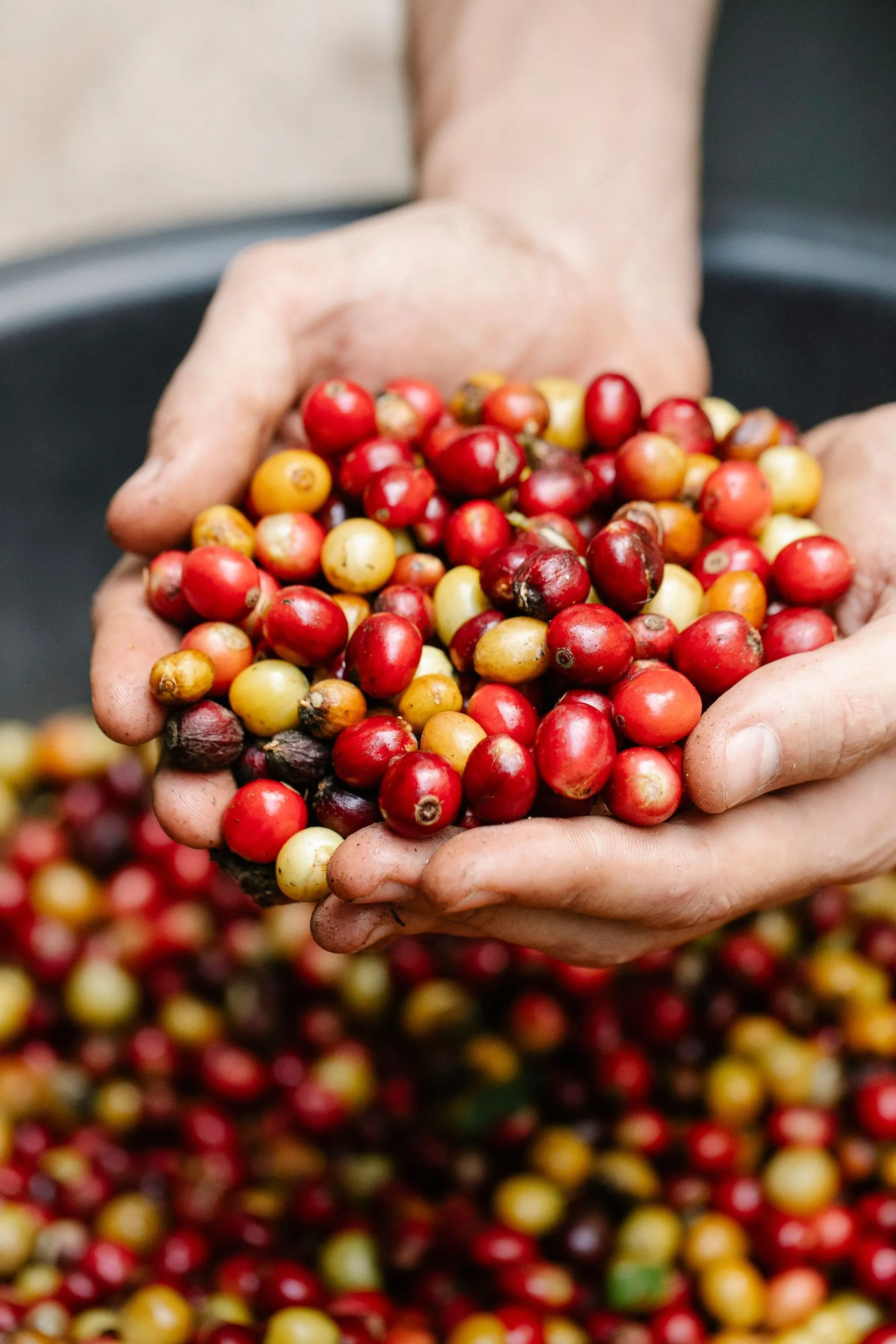
For decades, most Colombian coffee was sold under one name: Colombia. Today a buyer can ask for a specific variety, from a specific farm, and three names come up again and again on roaster menus and competition tables: Pink Bourbon, Chiroso and Geisha.
All three are expressive, floral and harder to grow than the varieties that fill most Colombian farms. Here is what sets each one apart and what to keep in mind before you buy.
Why varieties matter now
Most Colombian coffee comes from a handful of productive, disease-resistant varieties such as Castillo, Colombia and Caturra. They make reliable, sweet and balanced cups, and they are the backbone of the country's production.
The varieties in this article are different. They tend to produce less coffee per tree, they are more sensitive to disease and weather, and they need careful picking. In exchange, they can deliver unusually aromatic cups. That trade-off is why they are scarcer, why they cost more and why roasters use them for limited releases and competitions.
Geisha: the variety that changed the market
Geisha (also written Gesha) traces back to wild coffee collected in Ethiopia in the 1930s. It travelled through research stations in Africa and Central America and was planted for decades without much attention. That changed in 2004, when a Geisha from Hacienda La Esmeralda in Panama stood out at the Best of Panama competition and began setting price records.
In the cup: jasmine and other white flowers, bergamot, citrus, stone fruit, and a light, tea-like body.
On the farm: tall, open plants with long branches and low yields. Geisha usually needs high altitude to show its floral side; grown low, it can taste surprisingly ordinary.
In Colombia, Geisha is grown in several regions, and the best lots compete with the most famous ones from Central America.
Pink Bourbon: the Huila favourite
Pink Bourbon (Bourbon Rosado in Spanish) was found in the department of Huila. Its cherries ripen to a pink-orange colour instead of the usual red or yellow, and that is where the name comes from.
Despite the name, genetic testing has shown that it is closer to Ethiopian landrace varieties than to traditional Bourbon. Many producers still use the name because it is how the coffee became known.
In the cup: bright, juicy acidity, florals, citrus, red fruit and a lot of sweetness. In a 2023 tasting by Coffee Review, Pink Bourbon samples averaged around 90 points.
On the farm: the pink colour makes ripeness harder to judge, so pickers need training, and pink plants may produce cherries of other colours. Good Pink Bourbon depends on very selective picking.
Chiroso: the Antioquia newcomer
Chiroso comes from the area around Urrao, in Antioquia. Its beans are long and narrow, and like Pink Bourbon, it is believed to be related to Ethiopian landraces rather than to the varieties traditionally planted in Colombia.
In the cup: florals, stone fruit, citrus and a juicy, elegant acidity. It is often compared with Geisha for its aroma, at a lower price point. In the same Coffee Review tasting, Chiroso samples averaged around 89 points.
On the farm: small volumes and limited plantings so far, which makes Chiroso one of the rarer Colombian coffees to find as a single lot.
How the three compare
| Geisha | Pink Bourbon | Chiroso | |
|---|---|---|---|
| Origin of the name | Gesha, Ethiopia | Pink cherries, Huila | Urrao area, Antioquia |
| Typical profile | Jasmine, bergamot, tea-like | Juicy, floral, red fruit | Floral, stone fruit, elegant |
| Yield | Low | Low to medium | Low |
| Price | Highest | High | High |
These are general tendencies. Altitude, process and the producer's work change the cup as much as the variety does, which is why a sample always matters more than a name.
What to check before you buy
- Ask how the variety was identified. Names travel faster than seeds. A serious supplier can tell you where the plants came from and how the lot was kept separate.
- Cup before you commit. Order samples and taste them next to a coffee you already know. Florals are delicate: you want to see them in your own cupping, not only on a description.
- Check the process. Many of these lots are also fermented in special ways. That can add fruit and intensity, but it also changes what you are paying for. If you want the variety to speak, a washed lot is the clearest window.
- Plan for small volumes. Lots are often small and sell out within the harvest. If a coffee will anchor a menu, agree on quantities early.
- Roast with care. Most roasters keep these coffees light to medium to protect the florals, and many serve them as filter or as a special espresso.
Who should buy them
These varieties make sense if you want a signature coffee: a limited release, a competition coffee, a tasting flight or a premium filter that gives your customers a reason to ask questions. For everyday espresso, a sweet, consistent Castillo or Caturra is usually the better value.
At Almaguer, our catalogue includes Geisha, Chiroso and Bourbon Rosado lots, each with its region, municipality, altitude, process and SCA score. See the lots or order samples to cup them side by side.